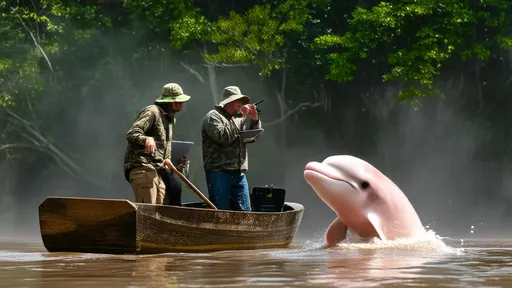
Deep in the heart of the Amazon rainforest, a team of scientists has made a breathtaking discovery that has sent ripples through the world of marine biology. A newly identified species of pink river dolphin, now officially named Inia araguaiaensis, has emerged from the murky waters of Brazil’s Araguaia River basin. This elusive creature, with its striking rose-colored hue and unique genetic markers, represents not just a scientific breakthrough but also a symbol of the Amazon’s untapped biodiversity.
The journey to uncover this hidden gem of the river was anything but straightforward. For years, local fishermen whispered about sightings of an unusual pink dolphin that didn’t quite match the known species. These anecdotal accounts eventually reached the ears of Dr. Marcelo Rocha, a marine biologist who had spent over a decade studying freshwater cetaceans. Intrigued, he assembled a team of researchers and set out on an expedition into the labyrinthine waterways of the Araguaia, where the dense jungle canopy and shifting river currents made every step of the mission a challenge.
What they found exceeded all expectations. Unlike the more common Amazon river dolphin (Inia geoffrensis), this newly documented species exhibited distinct physical and behavioral traits. Its pink coloration was more vibrant, its snout slightly longer, and its dorsal fin less pronounced. Genetic analysis later confirmed that the population had been isolated from other river dolphins for over two million years, likely due to geological shifts that created the Araguaia River’s unique ecosystem. "This isn’t just a new species—it’s a living relic," Dr. Rocha remarked during a press conference in Manaus. "Its existence tells a story of evolution that we’re only beginning to understand."
The discovery has sparked both excitement and urgency among conservationists. The Araguaia basin, though rich in wildlife, faces mounting threats from deforestation, illegal fishing, and proposed dam projects. Estimates suggest that fewer than 1,000 of these pink dolphins remain, making them critically endangered from the moment of their scientific recognition. "Naming a species is bittersweet when its habitat is under siege," said Dr. Rocha. "We’re in a race against time to protect these creatures before they vanish."
For the indigenous communities living along the riverbanks, the pink dolphin has long held cultural significance. Known as "boto-rosa" in local lore, it features prominently in myths as a shape-shifting enchantress or a guardian spirit of the waters. Some tribes even consider harming the dolphins to be a taboo. "Science is finally catching up to what our ancestors always knew," remarked Tuira Kayapó, a leader of the Kayapó people. "These beings are sacred, and their survival is tied to ours."
As researchers continue to study Inia araguaiaensis, questions abound about its role in the ecosystem. Early observations suggest it may have a unique diet, feasting on armored catfish and crustaceans ignored by other dolphins. Its sonar capabilities also appear adapted to the Araguaia’s silt-heavy waters. Each revelation underscores how much remains unknown about the Amazon’s hidden worlds—and how many more mysteries may still lurk beneath its surface.
The story of the pink river dolphin is more than a scientific headline; it’s a call to action. In revealing this species, researchers have also exposed the fragility of its home. The same waters that conceal such wonders are being eroded by human activity at an alarming rate. Protecting the Araguaia basin now isn’t just about saving a dolphin—it’s about preserving a chapter of Earth’s history that we’ve only just begun to read.

By /Aug 6, 2025

By /Aug 6, 2025
By /Aug 6, 2025

By /Aug 6, 2025

By /Aug 6, 2025

By /Aug 6, 2025

By /Aug 6, 2025

By /Aug 6, 2025

By /Aug 6, 2025

By /Aug 6, 2025

By /Aug 6, 2025

By /Aug 6, 2025

By /Aug 6, 2025

By /Aug 6, 2025

By /Aug 6, 2025

By /Aug 6, 2025

By /Aug 6, 2025

By /Aug 6, 2025

By /Aug 6, 2025

By /Aug 6, 2025
