While Mykonos has long been the crown jewel of the Cyclades, drawing jet-setters and party-goers with its glamorous beaches and vibrant nightlife, a whisper has begun circulating among seasoned travelers. Just a short boat ride northeast of this famed island lies an untouched speck of land—Delos’ shy cousin, if you will—that promises the kind of unspoiled beauty modern Greece has nearly forgotten.
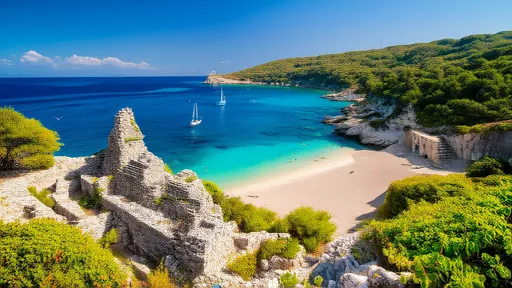
The island, known locally as Rineia, floats in relative obscurity despite its proximity to one of the Mediterranean’s most touristed hotspots. Unlike its glittering neighbor, Rineia has no boutique hotels, no DJ-fueled beach clubs, not even a proper village. What it lacks in infrastructure, however, it more than compensates for with crystalline coves that melt into the Aegean’s signature blues and stretches of wild terrain where goats outnumber humans.
History breathes through Rineia’s rocky soil. In antiquity, the island served as a quarantine zone for Delos when the sacred island banned births and deaths to maintain ritual purity. Later, it became agricultural land for wealthy Delians. Today, those with sharp eyes can still spot ancient terraces carved into hillsides—ghostly echoes of vineyards that once supplied grapes to classical Greece’s elite.
The magic of this place reveals itself in subtle ways. At dawn, when the first light catches the chapel of Agios Georgios (one of the island’s few structures), the whitewashed walls glow like heated marble. By midday, the sun transforms the shallows around Kato Koufonisi into a liquid mosaic where every pebble on the seafloor becomes distinct. Come evening, the lack of artificial lighting allows the Milky Way to drape itself across the sky with a brilliance city dwellers have never witnessed.
Getting to Rineia requires determination. No regular ferries make the crossing, leaving visitors to negotiate with local fishermen or charter small private boats. The journey itself becomes part of the adventure—watching Mykonos’ silhouette shrink against the horizon while dolphins occasionally race alongside the hull. Most day-trippers from Mykonos never venture beyond the first beach, meaning those willing to hike fifteen minutes inland might not encounter another soul for hours.
The island’s ecological significance is gaining attention. Marine biologists have identified seagrass meadows off Rineia’s western coast that serve as critical habitats for endangered Mediterranean monk seals. On land, the absence of development has allowed migratory birds to continue using the island as a resting point during their annual journeys between Africa and Europe. Conservationists quietly hope Rineia might become a model for sustainable tourism before mass discovery inevitably occurs.
For now, Rineia remains a place where time moves differently. Visitors speak of losing track of hours while watching the hypnotic dance of light on water, or of feeling the weight of history while sitting among ruins that haven’t been cataloged by archaeologists. There’s no Wi-Fi signal strong enough to reach here, no influencer staging the perfect sunset shot—just the salt-kissed air and the understanding that some places still exist outside the frantic pace of modern travel.
As more travelers seek alternatives to overcrowded destinations, whispers about Rineia are growing louder. The question lingers: how long can this tiny island maintain its quiet magic before the world comes knocking? For those who’ve walked its shores, the hope is that any future development honors the fragile balance that makes this place extraordinary. Until then, Rineia waits—a humble counterpoint to Mykonos’ dazzle, proof that Greece still keeps some secrets if one knows where to look.

By /Aug 6, 2025
By /Aug 6, 2025
By /Aug 6, 2025
By /Aug 6, 2025
By /Aug 6, 2025

By /Aug 6, 2025
By /Aug 6, 2025
By /Aug 6, 2025

By /Aug 6, 2025
By /Aug 6, 2025
By /Aug 6, 2025
By /Aug 6, 2025
By /Aug 6, 2025
By /Aug 6, 2025

By /Aug 6, 2025
By /Aug 6, 2025
By /Aug 6, 2025
By /Aug 6, 2025
By /Aug 6, 2025
By /Aug 6, 2025
