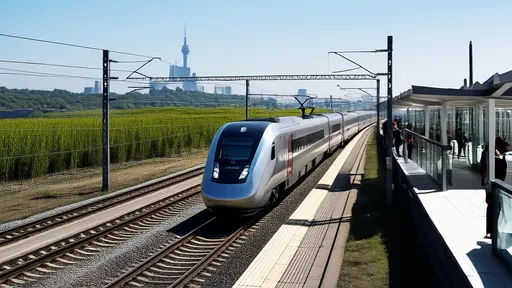
The much-anticipated Kuala Lumpur-Singapore High-Speed Rail (HSR) has finally commenced operations, marking a transformative milestone in cross-border travel between Malaysia and Singapore. This engineering marvel promises to redefine regional connectivity with its blistering 2-hour journey time, effectively shrinking the distance between the two Southeast Asian hubs. As commuters and leisure travelers alike flock to experience this revolutionary service, the HSR stands poised to become the backbone of transnational mobility in the region.
A New Era of Cross-Border Commuting
Gone are the days of tedious immigration queues and congested causeways. The HSR's seamless integration of customs clearance procedures allows passengers to complete both countries' immigration checks at their departure station - a groundbreaking "one-stop clearance" system that eliminates mid-journey disruptions. Business travelers particularly relish this efficiency; what was once a half-day ordeal now condenses into a quick morning dash. "I can attend a breakfast meeting in Singapore and be back in KL for lunch without breaking a sweat," shares frequent traveler Mohd Rizal as he sips coffee in the premium cabin.
The trains' interior design reflects a thoughtful blend of Malaysian and Singaporean sensibilities, with Malay batik motifs subtly incorporated into Singaporean-designed ergonomic seating. Every carriage maintains perfect climate control despite the tropical heat outside, while panoramic windows frame breathtaking views of Johor's lush landscapes giving way to Singapore's urban skyline. The ride remains whisper-quiet even at maximum speeds of 350 km/h, a testament to advanced Japanese Shinkansen-derived suspension technology adapted for Southeast Asian conditions.
Culinary Diplomacy at 300 km/h
Dining aboard the HSR has become an unexpected highlight, transforming what could have been utilitarian catering into a moving showcase of regional gastronomy. Rather than standard rail meals, passengers can choose between signature nasi lemak prepared by Kuala Lumpur's famed Village Park Restaurant or Singapore's Michelin-starred chicken rice from Tian Tian - both served at perfect temperature thanks to innovative induction heating trays. The menu rotates weekly to include Penang assam laksa, Melaka satay celup, and Singapore chili crab buns, creating what food blogger Janet Lim calls "the world's fastest-moving hawker center."
Beverage service similarly celebrates cross-strait traditions, offering everything from Ipoh white coffee to Singapore slings crafted by trained mixologists in the dedicated bar carriage. First-class passengers receive complimentary tastings of premium teas from Malaysia's Cameron Highlands paired with Singaporean kueh desserts - a thoughtful touch that's sparked numerous social media posts. "They've managed to compress the entire culinary journey of the Malay Peninsula into 120 minutes," remarks chef and frequent rider Ismail Hassan.
Economic Ripple Effects Beyond the Rails
The HSR's impact already extends far beyond transportation. Property values around Bandar Malaysia station have surged 27% since operations began, while Singapore's Jurong Lake District reports unprecedented interest from multinational corporations seeking dual-country headquarters. Analysts note a marked increase in same-day business meetings between the two financial centers, with some firms reducing their Singapore-based expatriate housing allowances now that daily commuting becomes feasible.
Tourism patterns show equally dramatic shifts. Where previous visitors typically chose either Malaysia or Singapore for short getaways, integrated HSR-hotel packages encouraging multi-destination trips have surged in popularity. The "Twin Capitals" weekend itinerary - combining Friday night in Kuala Lumpur's Bukit Bintang with Saturday in Singapore's Marina Bay - has become particularly viral among younger travelers. "It's like having two vacations in one," explains honeymooner Sarah Wu, showing photos from her Merlion selfie and Petronas Towers visit within the same 36-hour period.
Perhaps most significantly, the project has fostered unprecedented bilateral cooperation in urban planning. The two nations recently announced synchronized development blueprints ensuring seamless connectivity between HSR stations and local transit networks. Singapore's Cross Island MRT Line will directly link to the HSR terminus, while Malaysia's MRT3 Circle Line will similarly integrate with the Bandar Malaysia hub - creating what transport ministers hail as "the first truly unified metropolitan region spanning international borders."
Technical Marvel Meets Cultural Bridge
Behind the HSR's sleek facade lies an extraordinary technological symphony. The system employs adaptive signaling that automatically adjusts speeds during Malaysia's frequent afternoon thunderstorms without human intervention. Specially designed track absorbers minimize vibration near sensitive ecological areas along the route, particularly important when traversing Johor's RAMSAR wetland sites. Engineers from both countries collaborated on a unique dual-voltage system allowing seamless transition between Malaysia's 25kV AC and Singapore's 750V DC electrification standards.
Yet beyond hardware, the HSR's true achievement may be cultural. Onboard signage appears in Malay, English, Chinese, and Tamil - reflecting both nations' multicultural fabric. The staff recruitment process deliberately selected bilingual attendants equally fluent in Manglish and Singlish, creating an environment where passengers from either country feel immediately at home. This careful attention to soft infrastructure has turned the trains into rolling diplomacy chambers, where spontaneous exchanges between Malaysian and Singaporean passengers have become commonplace.
As the HSR celebrates its first months of operation, planners already envision extensions northward to Thailand and eventual connections to China's Belt and Road network. But for now, the focus remains on perfecting what many call "the two-hour miracle" - a daily demonstration that geography need not dictate destiny, and that even historic rivals can build bridges when shared ambition outpaces old divisions. The last word perhaps goes to octogenarian Madam Lim, traveling with her Singaporean granddaughter to visit Malaysian relatives: "In my youth, this journey took twelve hours by ferry and bus. Today we'll be there before my kopi gets cold."

By /Aug 6, 2025
By /Aug 6, 2025

By /Aug 6, 2025

By /Aug 6, 2025

By /Aug 6, 2025

By /Aug 6, 2025

By /Aug 6, 2025

By /Aug 6, 2025
By /Aug 6, 2025

By /Aug 6, 2025
By /Aug 6, 2025

By /Aug 6, 2025

By /Aug 6, 2025

By /Aug 6, 2025

By /Aug 6, 2025

By /Aug 6, 2025

By /Aug 6, 2025
By /Aug 6, 2025
By /Aug 6, 2025

By /Aug 6, 2025
